
What could be happier than spending it with our beautiful Granddaughter,
who is nine months old today, and her mummy and daddy 🙂
What could be happier than spending it with our beautiful Granddaughter,
who is nine months old today, and her mummy and daddy 🙂
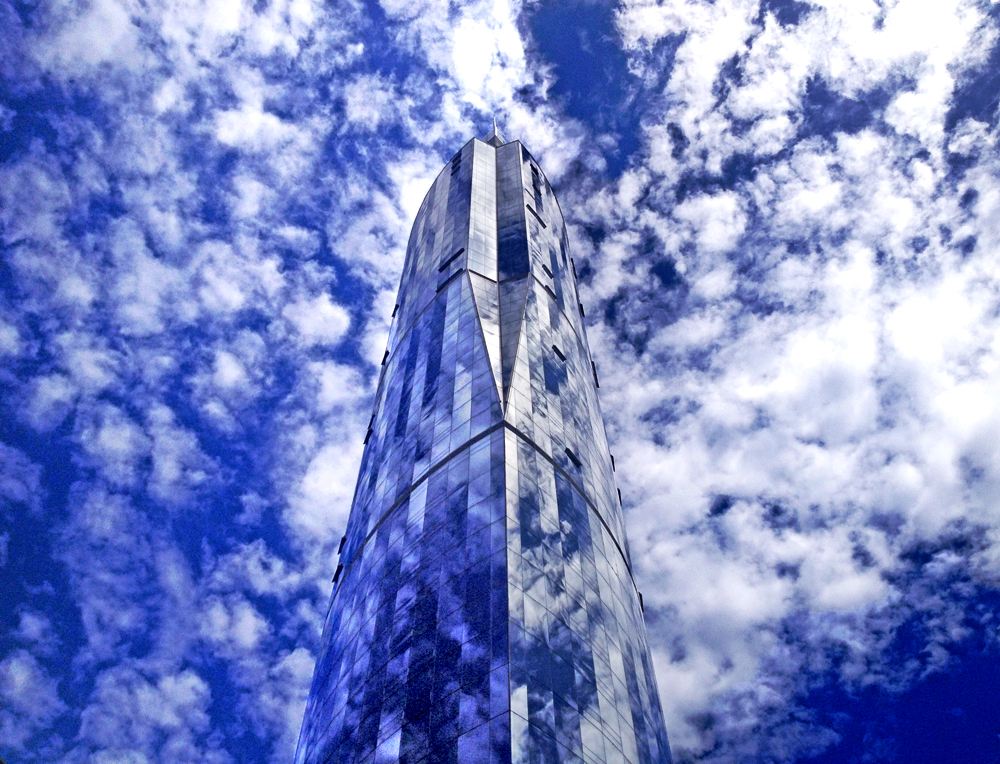
I’ve looked at clouds from both sides now
From up and down and still somehow
It’s cloud illusions I recall
I really don’t know clouds at all.
Joni Mitchell 1967
Last posted for the Weekly Photo Challenge: Half and Half in July last year, it seemed to be a good time to revisit one of my favourite photos, which was inspired by Joni Mitchell’s wonderful voice and poetry, for this week’s photo challenge from Krista who asks us to “Share a photo inspired by a poem, verse, song lyric or story.”
Joni Mitchell wrote “Both Sides, Now” in March 1967, inspired by a passage in Henderson the Rain King, a 1959 novel by Saul Bellow. (Wikipedia)I was reading Saul Bellow’s “Henderson the Rain King” on a plane and early in the book Henderson the Rain King is also up in a plane. He’s on his way to Africa and he looks down and sees these clouds. I put down the book, looked out the window and saw clouds too, and I immediately started writing the song. I had no idea that the song would become as popular as it did. Joni Mitchell.
Enjoy the unforgettable voice of Joni Mitchell singing one of her greatest songs once again.
Last June I was inspired by a CBC documentary on the Alberta Ballet Company’s Balletlujah, a celebration of the music of K.D.Lang. My posts on Days 170 and 173 of my 365 day challenge were an expression of that inspiration using photographs I took from my TV screen during the CBC broadcast. For this week’s Photo Challenge: Dance I thought I would revisit those photographs and share with you the magic and sublime beauty of the dancers as they performed both on stage and in the warm Canadian prairie sunshine to the magnificent voice of K.D.Lang.


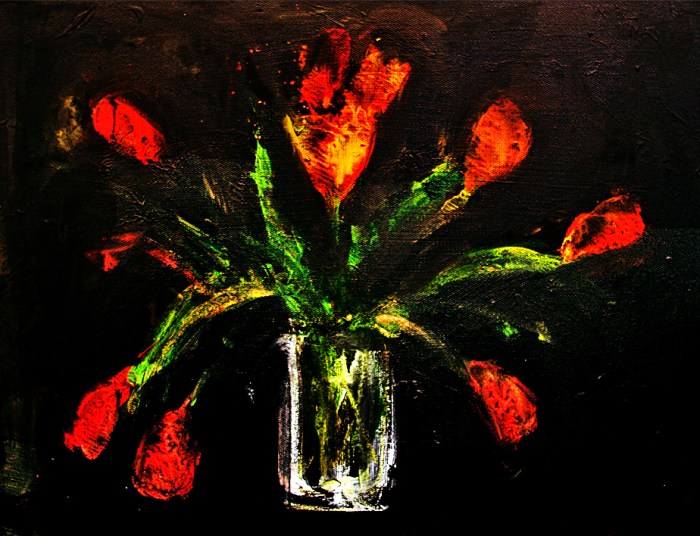
tulip burst after 14.3.16
 Those of you who follow my blog will not be surprised at my interpretation of one love today.
For this inaugural Discover Challenge: Blogging the Senses, Cheri asks us publish a post that piques one of the five senses, hearing, sight, touch, smell, and taste, having found inspiration herself in an interview with medieval book historian Erik Kwakkel. Since we are free to “interpret this in any way, and in any format: prose, poetry, photography, audio, video,” and having been also inspired by Erik Kwakkel’s blog myself thanks to Cheri’s introduction, I thought how appropriate this would be to revisit the Abbey of St. Antimo, a former Benedictine Monastry in the commune of Montalcino in Tuscany, which I blogged about over two years ago.
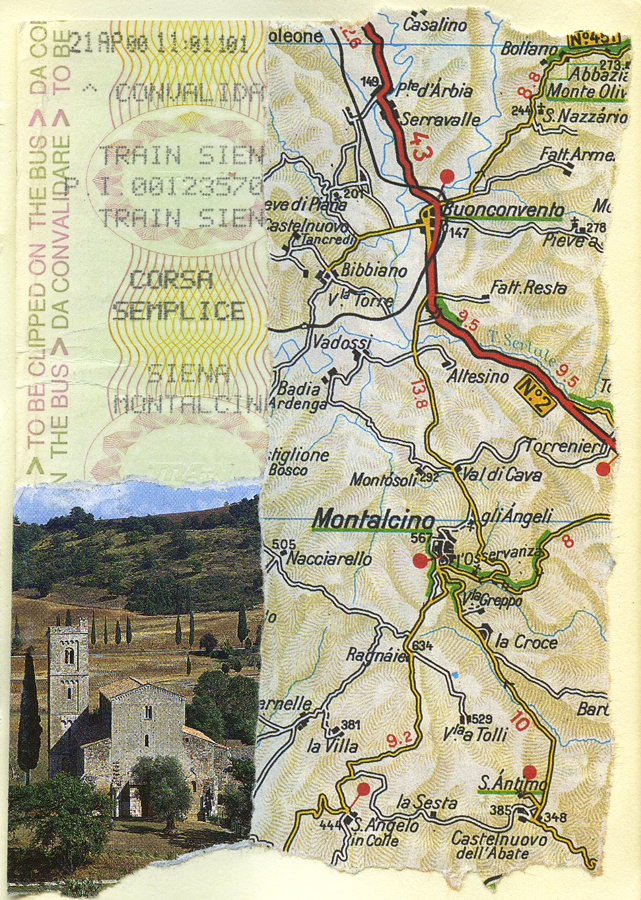
The map is from a journal I kept during our Italian travels in 2000, and the entry for the 21st of April describes our visit to the Abbey that day. As you can read we took the bus from Siena to Montalcino and then walked the 10 kilometres to St. Antimo.

The video is from the photographs I took during that memorable 10 kilometre walk through the magnificent Tuscan countryside. I hope your senses will be piqued as you enjoy the beauty of those Tuscan hills and listen to the Gregorian chant, “Haec Dies” from “Mysterium” a recording made in the Abbey in April 1995 by the five fathers of the Communita die Canonici Regolari di Sant’Antimo.
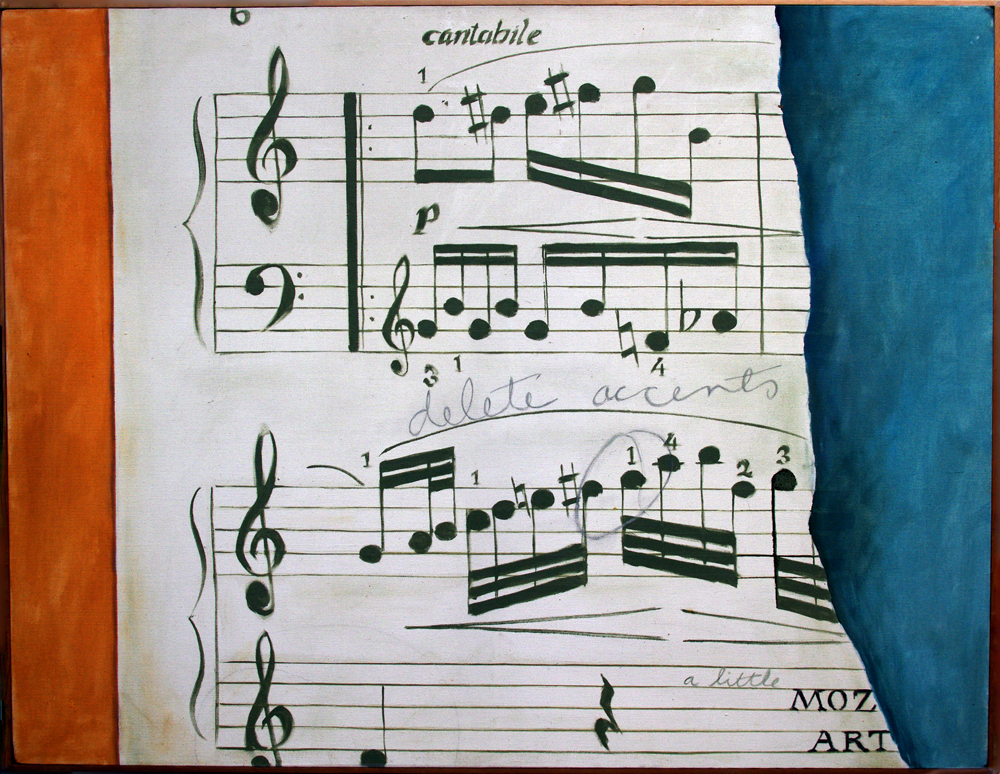
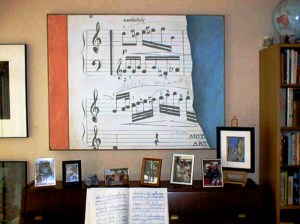
delete accents – acrylic on canvas 36″x 47″
Color harmony and tone come together with a little piece of Mozart.
The story of the painting, which I painted a few years ago, is worth re-telling. It began when I was attempting to master Mozart’s Piano Sonata in C, K 330, (without much success I might add). I had obtained a copy of the music in a music sale and as I struggled to learn it I became more and more intrigued by all of the marginalia written by whoever had been my predecessor. I particularly enjoyed, and could relate to, the note written presumably by his or her music teacher, “breathe”. You will find the small section I used for the painting at the top of the page.
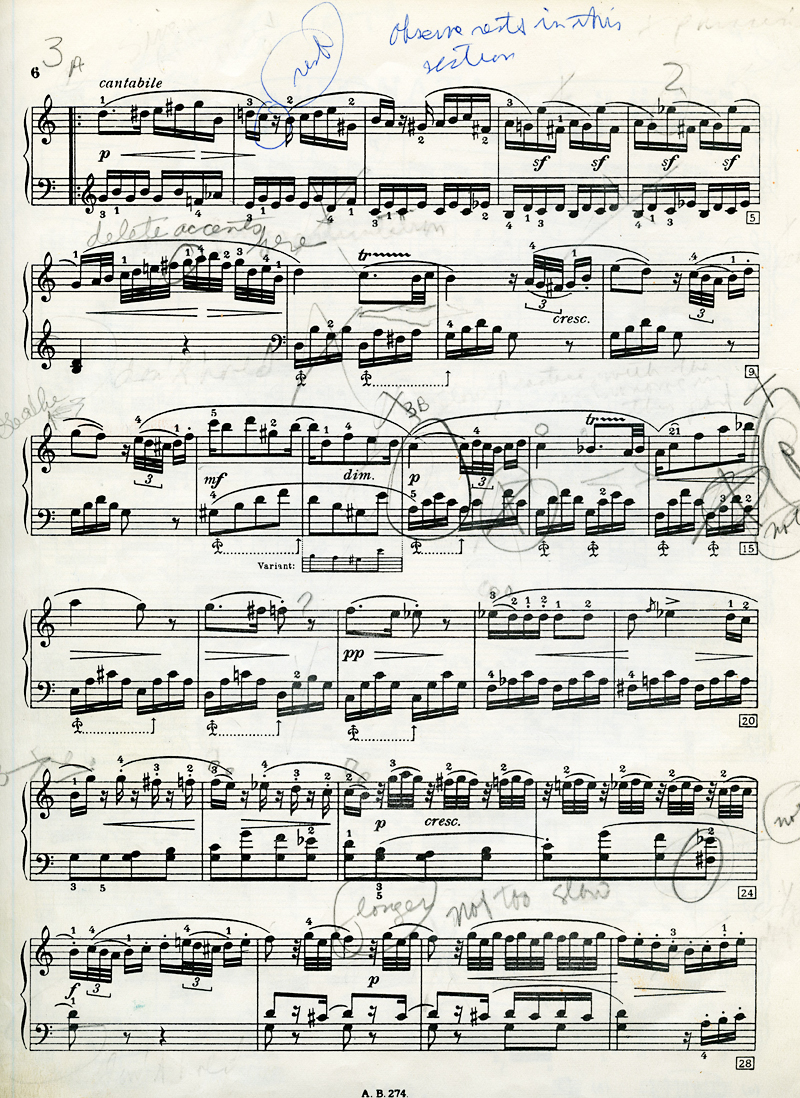
For the completeness of this week’s Photo Challenge I thought I would search for a recording of the Sonata and found one by Deutsche Grammophon of Vladimir Horowitz in 1986, which was recorded in Moscow.
Why not follow along with the music and enjoy the mastery of one of the greatest pianists who has ever lived.

state of mind 29.2.16
For this week’s photo challenge Ben reminds us that, “Every photo we take says something about our emotions at the moment of taking it.” His challenge this week is to “…share an image where you see a particularly strong connection between what we see and what you felt as you pressed that shutter button on your camera or phone.”

Our beautiful granddaughter is 8 months old today and when I took this photo of her on my iPhone two days ago my state of mind was simply one that was full of love, joy and gratitude.
I couldn’t resist posting this image from my archives as a second response to Jen’s photo challenge this week. She writes that the word “seasons” need not only embody the “world or the weather” where we live but can also express “the seasonality of life itself”, and asks us to share an image from a period or phase in our lives that resonates with this.
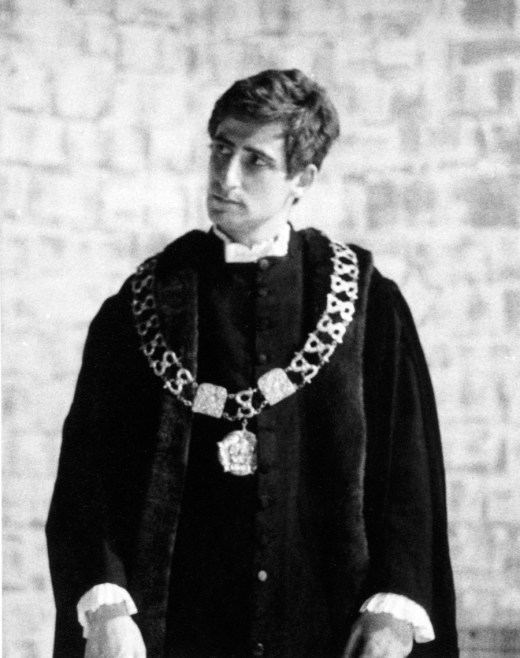
What could be more appropriate than this rather sombre photograph of me as a young student over fifty years ago playing the part of Sir Thomas More in an amateur production of Robert Bolt’s A Man for all Seasons. I was certainly no Paul Scofield, who played the part on the play’s opening night on July 1st 1960 at the Globe Theatre in London, but I believe I acquitted myself well enough.

We used this copy of the play for our production, reprinted for the sixth time by Heinemann in 1964 and another of my library’s treasures. This is Bolt’s description of Sir Thomas More from page xxiii:
SIR THOMAS MORE: Late forties.Pale, middle-sized, not robust. But the life of the mind in him is so abundant and debonair that it illuminates the body. His movements are open and swift bur never wild, having a natural moderation . The face is intellectual and quickly delighted, the norm to which it returns serious and compassionate. Only in moments of high crisis does it become ascetic-though then freezingly.
Was I debonair with a face that quickly delighted, becoming freezingly ascetic in moments of crisis? I somehow doubt it, and I’m not even sure I know what that means, but thinking back all those years ago and looking at the photo of me as a young man starting out on my life’s journey I feel the “seasonality of life” could not be better illustrated.

