
Self-portrait from my last operation before retiring as a general surgeon nearly six years ago.
This week’s Discover Challenge at The Daily Post is all about identity so finally, after starting my blog almost three years ago and now with close to a thousand followers, this seems like just the right opportunity to introduce myself, somewhat belatedly I agree, with this self portrait, and through part of an address I gave on the Art of Medicine at a National meeting a few years ago. If you have time to read it I hope you enjoy it and get to know me a little better than you do already.

“When I was asked to speak to you on the Art of Medicine I questioned myself as to whether or not I had the necessary credentials to address such an expert audience of educators and scholars on the subject. My only qualification, it seemed to me, was that of someone who has spent the last forty years practicing medicine and surgery, committed to helping patients to the best of my ability and dedicated to teaching students and residents, and passing on to them the knowledge, skills and art that had been passed on to me by my teachers, and always encouraging them to have the arts and humanities in their lives. Hopefully these qualifications will prove to be sufficient for my task this morning.
The art of medicine has three factors said Hippocrates… “the disease, the patient, the physician..”. a relationship that is as true today as it was over two millennia ago. But I would also like to add a fourth factor, the student. For without the student there is no future to the art. We all start out as students. We all have role models and teachers, who have guided us. That is why I have always believed that second only to my patients, my students have been the most important people in my professional life. Remember, our responsibility to be teachers is embedded in the Hippocratic oath
“…and that by precept, lecture, and every other mode of instruction, I will impart a knowledge of the Art…” reads the oath.
The art that was being imparted by Hippocrates however was founded in the belief that health was based on a balance of the elements: earth, fire, air and water; the humours: black bile, yellow bile, phlegm and blood; and the qualities of hot and cold or wet and dry. How very different is our understanding of the art today, which is based on scientific truths and the rigors of research that are so integral to the practice of medicine in the twenty first century.
There is no time in this presentation to catalogue all the scientific and clinical landmark contributions that have been made throughout the ages: Vesalius’s revelations of human anatomy in the 16th century; Harvey’s description of the circulation of the blood in the 17th; in the 18th Laenec and his stethoscope that changed, forever, the art of diagnosis; and then a few years later Moreton’s anaesthetic that set Surgery on its way; and the molecular biology and genetics of today. The message that I give to my students at every opportunity is to enrich their lives by studying the history of medicine and see unfold not only the history of our profession, but also the history of humanity.
In 1892 Sir William Osler published his Principles and Practice of Medicine, the definitive textbook of Medicine for the age. It seems only fitting to be quoting Osler at a meeting dedicated to medical education and the humanities in medicine. I opened a copy that I own, certain I would be enlightened in some way, and I was not to be disappointed, for there on the very first page was his dedication: “To the memory of my teachers.” What a great message to every practitioner opening this book, to be reminded that it is our teachers who must always be thanked for guiding us on our individual journeys. Then on the second page Osler quotes from the First Aphorism of Hippocrates ‘Experience is fallacious and judgement difficult”. It is interesting that he chose not to include the famous words that begin this aphorism: Vita brevis, ars longa, “Life is short, the Art is Long”, words that have become ever more meaningful to me as the vita becomes ever more brevis.
And this from his address to the New York Academy of Medicine in 1903:
“For the junior student in medicine and surgery it is a safe rule to have no teaching without a patient for a text, and the best teaching is that taught by the patient himself.”
How true that is. One of my patients is someone who has been an inspiration to me, and from whom I have learnt so much over the years. She is a remarkable young woman who has had Crohn’s disease from a very young age, has been through numerous surgeries and spent countless months in hospital throughout her life. I spoke with her about my presentation to you today and asked her for her perspective on the art of medicine. This is what she wrote to me:
“The Art of Medicine is maintaining the optimal balance between the scientific expertise and treatment of injury and disease, and the humanity and humility of character necessary in the promotion of a patient’s overall health and well being…Doctors today have a need for adaptability that never was present before but that being said… I believe that more and more it is up to the patient to be an active participant in their own care and treatment.”
Another of my patients writes: “The Art of Medicine is projecting a quiet but strong confidence such that the patient never doubts a positive outcome”.
From an anaesthetist colleague: “The art of medicine is the balance of science, skill, passion and compassion”.
From a surgical trainee: “The art of medicine is the ability to convince your patient that you recognize their humanity and see them as a complete human being.”
And from a first year student: “Medicine is a demonstration of love: love for humankind, curiosity for cure and a hope for the future”. Remarkable insight from a someone just beginning their studies and so very close to the words of Hippocrates, written over two thousand years ago, ”Where there is love for humanity,” he wrote “there is love for the art of medicine.”
And so, we learn from our teachers, we learn from our patients, we learn from our colleagues and we learn from our students. I’m sure you will agree with me that our responsibility as teachers is to ensure that the passion, commitment, and remarkable humanistic and artistic spirits that reside in all of our students, as they begin their journeys, just as we did ours, are nurtured, celebrated and supported at every opportunity.
My belief is that the art of medicine is about hearing as well as listening, about seeing as well as looking, about caring as well as treating and about feeling as well as touching. Perhaps, in no greater way is trust between a doctor and a patient expressed than in the laying on of hands Touching is one of the most intimate acts that we perform as physicians. It is sacred, a defining moment, for in its action our patients know how much we care. They permit us to palpate, to percuss, to incise. My earliest memories as a medical student were watching the manner in which my teachers would touch their patients. The gentle holding of the hand, the taking of the pulse, the steady palpation to reveal the site of pain, the handshake of greeting that, with its strength, tells the patient, I am here and this moment is yours. This universal image of a student and a teacher communicating with their patient is one that I believe captures the essence of the art of medicine and one that I expressed to the students at the end of a graduation address I gave some years ago:
Listen and you will hear.
Look and you will see.
Touch and you will feel.
Treat and you will care.
Practice your art with compassion
And live your lives with passion.
Be a student always
And a teacher ever,
And your lives will be as fulfilled
And meaningful as any who have gone before
And any who are yet to come.”
So dear followers and fellow bloggers if you made it to the end, thanks for reading all the way and learning more about this truly blest husband, father, grandfather, surgeon, teacher and artist. As you know art is an important part of my life and has been since I was a young boy. Now that I am retired, although I do still teach and assist in surgery, I am able to spend more time in my studio and hope to continue to improve in the years to come.
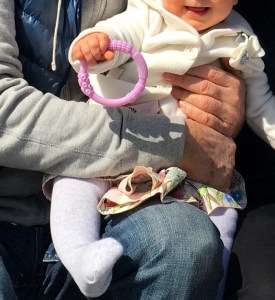
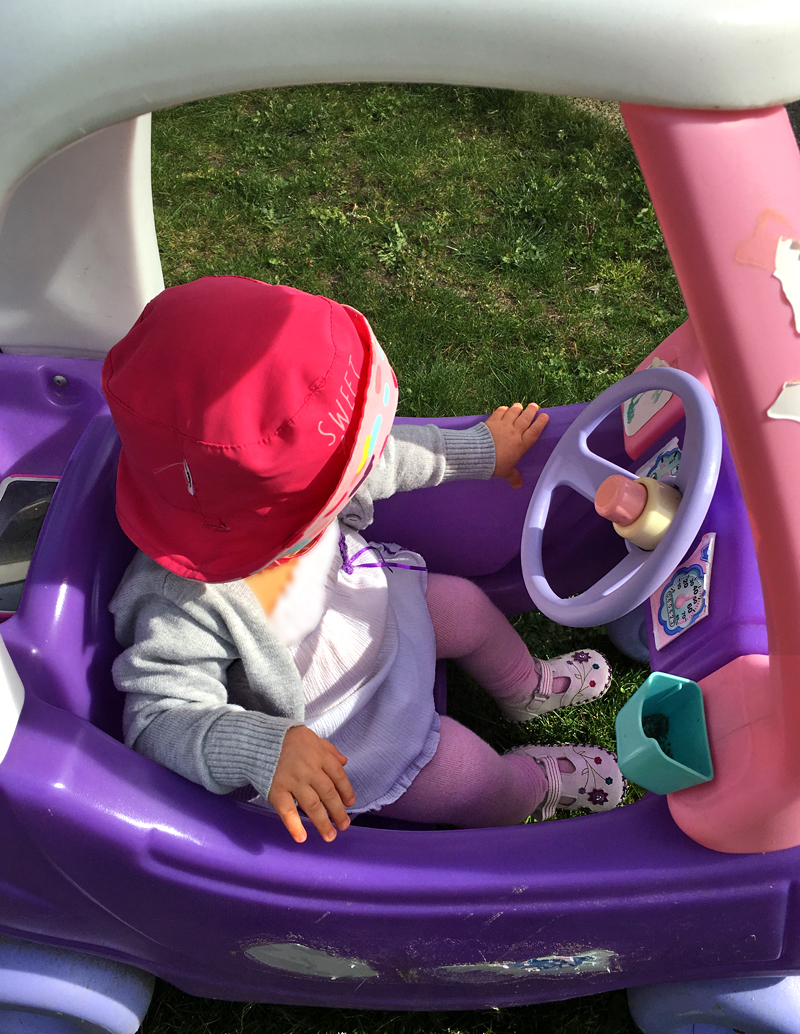
Last week the subject I chose, not surprisingly, for the Weekly Photo Challenge: Future was my beautiful granddaughter who I hope one day will read today’s post and learn something about her besotted grandpa who loves her more than she could ever know.









 thechangingpalette